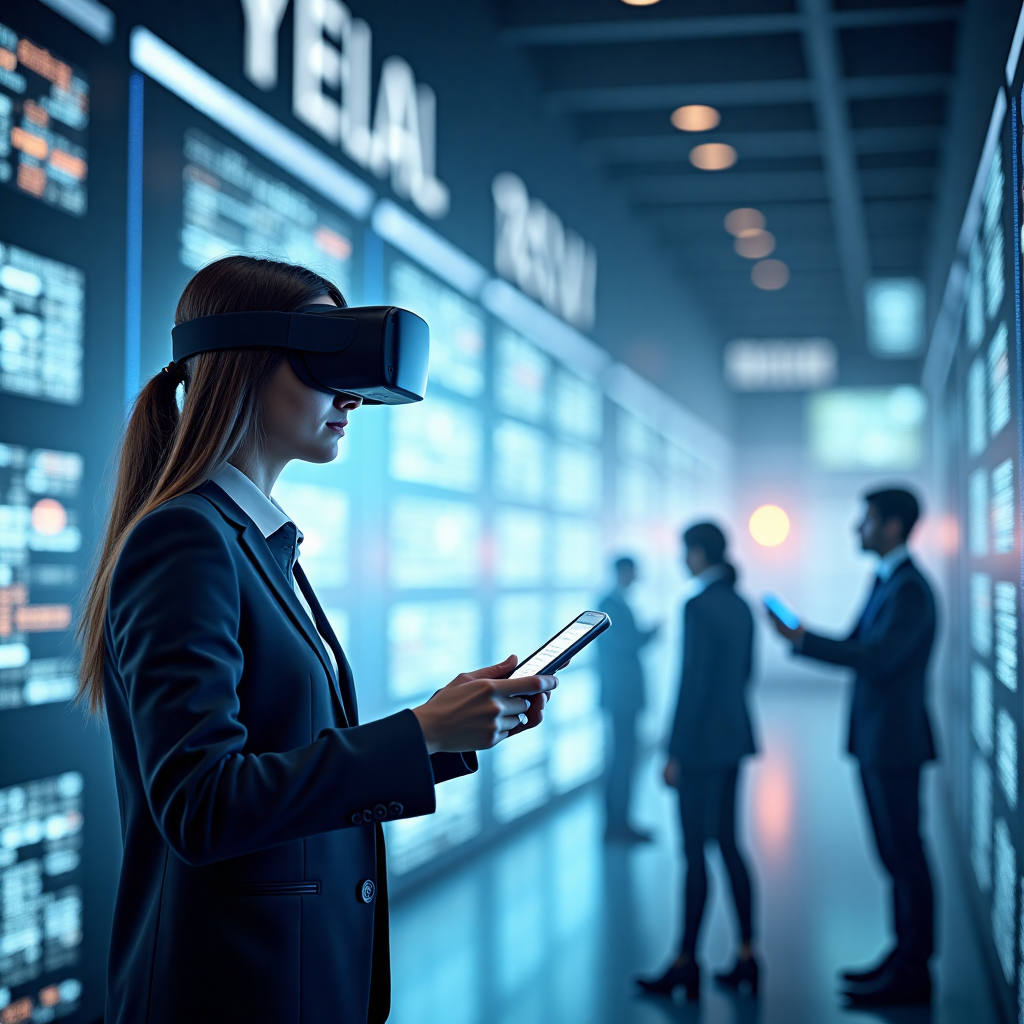
In recent years, virtual reality (VR) has emerged as a groundbreaking technology with the potential to revolutionize various industries, including education. Traditionally, learning environments have been confined to physical classrooms, textbooks, and lectures. However, VR offers a new dimension of immersive and interactive experiences that can make education more engaging, accessible, and effective. This article explores how virtual reality is reshaping the educational landscape, its benefits, and the challenges it presents.
Revolutionizing Learning Experiences
Virtual reality in education is not just a gimmick; it is a powerful tool that can transform the way students learn. By creating immersive environments, VR allows students to visualize and interact with complex concepts in ways that were previously impossible. For example, in science classes, students can explore the human body in 3D, travel through space to understand the solar system, or even witness historical events as if they were there. This level of engagement can lead to better retention of information and a deeper understanding of subjects.
Immersive Learning Environments
One of the most significant advantages of VR in education is its ability to create immersive learning environments. These environments can simulate real-world scenarios, enabling students to practice and learn in a risk-free setting. For instance, medical students can perform virtual surgeries, engineering students can design and test structures, and language learners can practice speaking in virtual foreign environments. This hands-on approach to learning can be particularly beneficial for kinesthetic learners who thrive on physical interaction and experience.
- Medical Training: VR simulations allow students to practice procedures without the risk of harming real patients.
- Engineering and Architecture: Students can design and test virtual models, gaining practical experience before working on real projects.
- Language Acquisition: VR environments can replicate real-life conversations, helping students improve their fluency and confidence.
Interactive Simulations
Interactive simulations are another key feature of VR in education. These simulations can provide students with a deeper understanding of abstract concepts by allowing them to manipulate variables and observe outcomes in real-time. For example, physics students can experiment with gravitational forces, chemistry students can visualize molecular structures, and history students can explore ancient civilizations. This interactivity fosters critical thinking and problem-solving skills, making learning more dynamic and effective.
- Science Education: VR can help students visualize and interact with scientific phenomena, such as the movement of electrons or the structure of DNA.
- Mathematics: Students can solve geometric problems by manipulating virtual shapes and figures.
- Environmental Studies: VR can simulate ecosystems, allowing students to study the impact of human activities on the environment.
Enhancing Engagement and Retention
Engagement is a critical factor in effective learning. VR has the potential to increase student engagement by making lessons more interactive and enjoyable. According to studies, students who use VR in their learning are more likely to remember the material because it creates a memorable and multisensory experience. This is especially important in subjects that are often perceived as dry or uninteresting, such as mathematics or history.
Improved Retention Through Immersive Learning
Research shows that students who learn through immersive VR experiences retain information better than those who learn through traditional methods. This is because VR activates multiple senses, making the learning experience more vivid and memorable. For example, a student learning about the Great Wall of China can walk along it in a VR simulation, taking in the sights, sounds, and even the textures of the environment. This kind of experience can make the subject matter more relatable and easier to remember.
- Historical Reenactments: Students can experience historical events, such as the signing of the Declaration of Independence or the fall of the Roman Empire, in a lifelike manner.
- Geography: VR can transport students to different parts of the world, allowing them to explore landscapes and cultures without leaving the classroom.
- Art and Design: Students can create and modify 3D art pieces, gaining a better understanding of spatial relationships and design principles.
Personalized Learning Experiences
VR also offers the possibility of personalized learning experiences. Each student can progress at their own pace, revisiting difficult concepts or exploring topics in greater depth. This level of customization can cater to different learning styles and needs, making education more inclusive and effective. For example, students with learning disabilities can benefit from VR’s multisensory approach, while advanced learners can tackle more complex challenges in a virtual environment.
- Adaptive Content: VR platforms can adjust the difficulty of lessons based on a student’s performance, ensuring that each student is challenged appropriately.
- Visual and Auditory Learners: VR’s immersive nature caters to both visual and auditory learners, providing a rich sensory experience.
- Hands-On Practice: Students can practice skills repeatedly in a virtual environment, reinforcing their learning and building confidence.
Challenges and Considerations
While virtual reality holds immense potential for education, there are also challenges that need to be addressed. These include the cost of VR equipment, the need for technical expertise, and the integration of VR into existing curricula. Additionally, there are concerns about the emotional and psychological impact of prolonged VR use, as well as the potential for distraction in immersive environments.
Cost and Accessibility
One of the biggest barriers to the widespread adoption of VR in education is the cost. High-end VR systems, such as those used in professional training, can be expensive. However, there are more affordable options available, such as cardboard VR headsets and mobile VR solutions. Despite these options, the cost of VR equipment can still be prohibitive for many schools, especially those in underfunded districts. This raises concerns about equity in education, as students in wealthier schools may have access to VR tools while others do not.
Technical Limitations
Another challenge is the technical limitations of VR systems. While the technology has advanced significantly in recent years, there are still issues with hardware performance, software compatibility, and content availability. For example, some VR systems may have limited resolution or field of view, which can affect the immersive experience. Additionally, creating high-quality VR content requires significant time and resources, which may not be feasible for all educational institutions. As a result, there is a need for more user-friendly tools and platforms that allow educators to create their own VR content without extensive technical expertise.
Integration into Curricula
Integrating VR into existing curricula is another consideration. Educators need to determine how VR can complement traditional teaching methods rather than replace them. This requires careful planning and alignment with educational standards. Moreover, teachers need to be trained in the use of VR tools to effectively incorporate them into their lessons. Without proper training, the potential of VR in education may not be fully realized, and its use could become more of a novelty than a meaningful educational tool.
Conclusion
Virtual reality is a powerful technology that has the potential to transform education. By creating immersive and interactive learning environments, VR can enhance student engagement, improve retention of information, and provide personalized learning experiences. However, the challenges of cost, technical limitations, and integration into curricula must be addressed to ensure that VR is accessible to all students and used effectively in the classroom. As the technology continues to evolve, it is likely that VR will play an increasingly important role in education, offering new opportunities for students to learn and grow in ways that were previously unimaginable.